Bundled examples
The examples/ directory contains runnable scripts demonstrating the
package’s core workflows. Every example accepts --help for a full
list of options and --list-interfaces for a table of all bundled
interfaces.
Quick reference
Script |
What it demonstrates |
Default interface |
Runtime |
|---|---|---|---|
|
Two-layer moire relaxation |
Graphene/Graphene (0.2 deg) |
2-3 min |
|
Relaxation penetration through a multi-layer stack |
Graphene/Graphene (0.035 deg, 60/60) |
10-30 min |
|
Inverse strain extraction + constrained relaxation |
MoSe2/WSe2 H |
seconds |
|
End-to-end strain extraction from data + relaxation |
MoSe2/WSe2 H |
~10 min |
|
TDBG 2DW network at very low twist |
TDBG-DFTD2 (0.02 deg) |
~7-8 min |
bilayer_relaxation.py
The main bilayer relaxation script. Runs any two-layer moire system (homobilayer or heterointerface) and produces stacking energy, elastic energy, and local twist angle maps.
Presets
Three named presets reproduce the classic demonstrations:
# Twisted bilayer graphene (default)
python bilayer_relaxation.py

# Graphene on hBN (pure lattice-mismatch moire)
python bilayer_relaxation.py --preset hbn

# H-stacked MoSe2/WSe2 (deep moire potential)
python bilayer_relaxation.py --preset tmd
Preset |
Interface |
Twist |
Pixel size |
Method |
Max iter |
gtol |
|---|---|---|---|---|---|---|
|
graphene |
0.2 deg |
1.0 nm |
newton |
60 |
1e-6 |
|
graphene-hbn |
0.0 deg |
0.5 nm |
L-BFGS-B |
300 |
1e-4 |
|
mose2-wse2-h |
1.5 deg |
0.5 nm |
L-BFGS-B |
300 |
1e-4 |
Any explicit CLI flag overrides the preset value:
python bilayer_relaxation.py --preset tmd --theta-twist 3.0
Sample output: twisted bilayer graphene (0.2 deg)
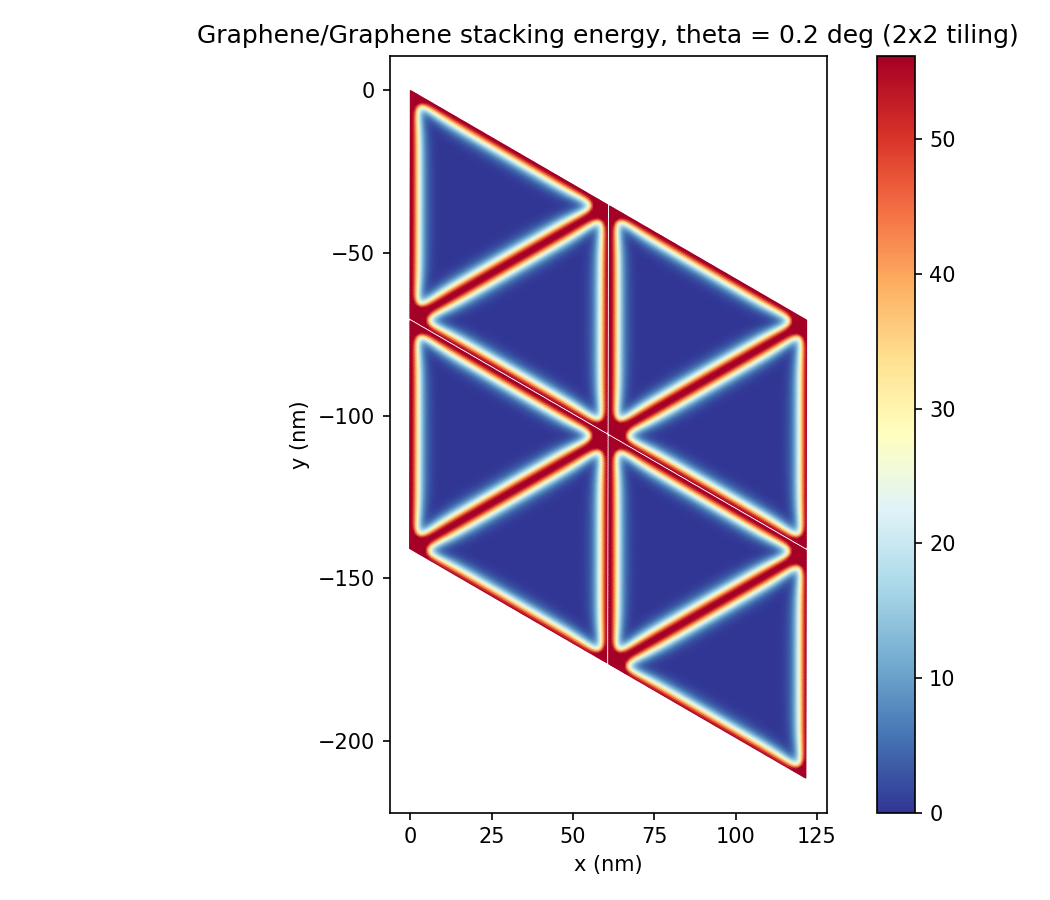
Stacking energy density showing the hallmark AB/BA triangular domain pattern with narrow domain walls (soliton network).
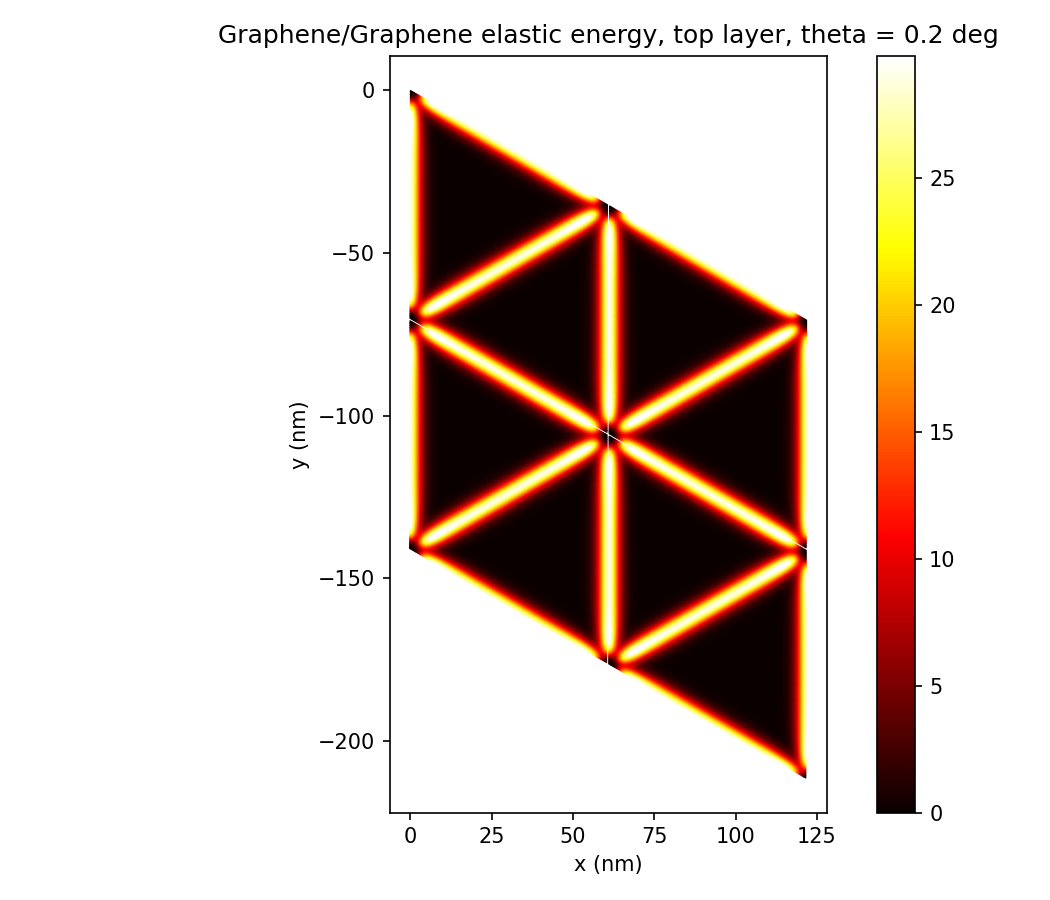
Elastic energy density concentrated along the domain walls, forming the strain-driven soliton network.
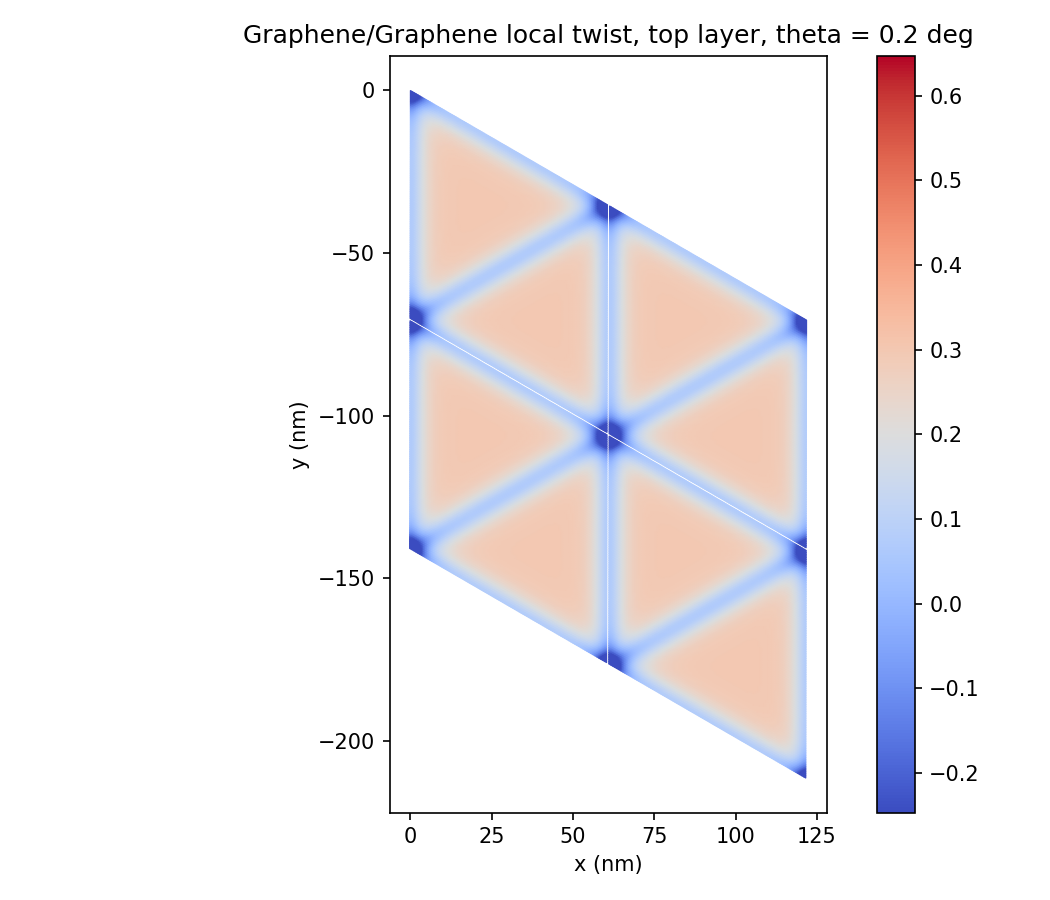
Local twist angle map showing enhanced twist at AA vortex sites and reduced twist in the relaxed AB/BA domains.
Sample output: graphene/hBN (0 deg, lattice-mismatch moire)
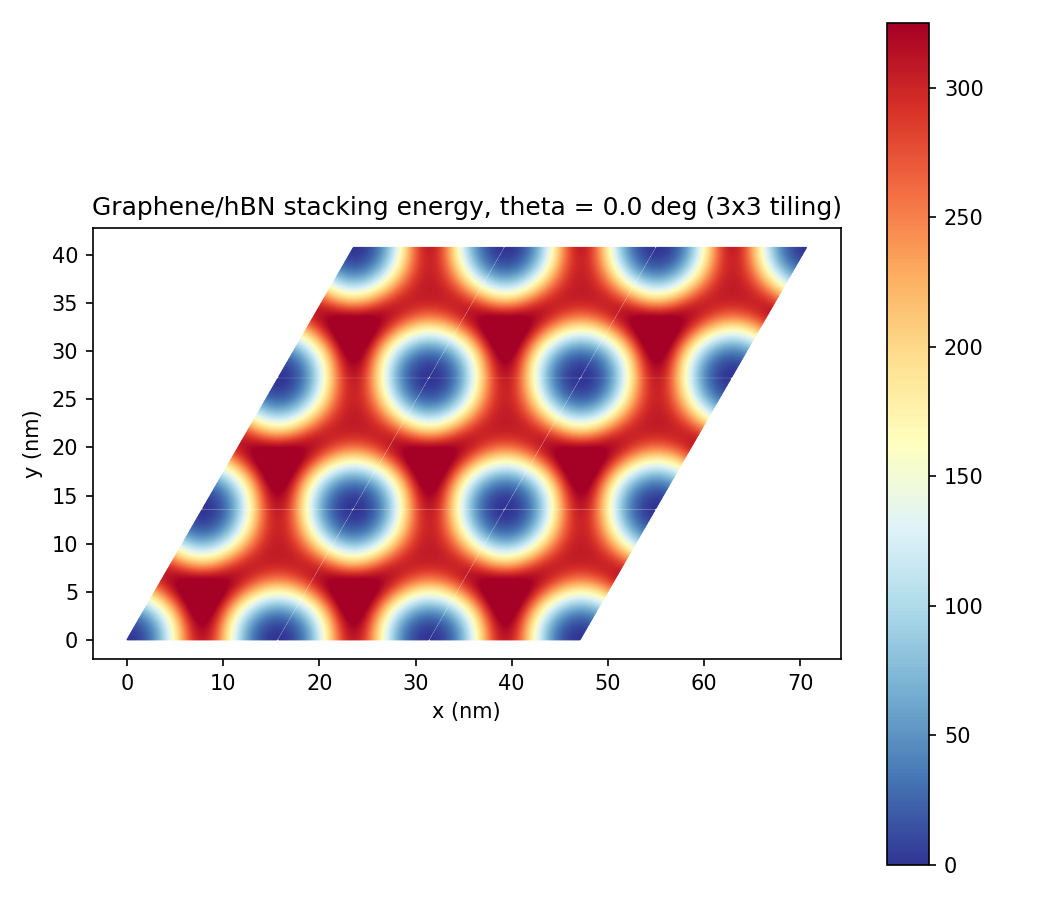
Graphene on hBN at zero twist. The 1.6% lattice mismatch drives a moire pattern with a single energy minimum per cell.
Sample output: MoSe2/WSe2 H-stacked (1.5 deg)
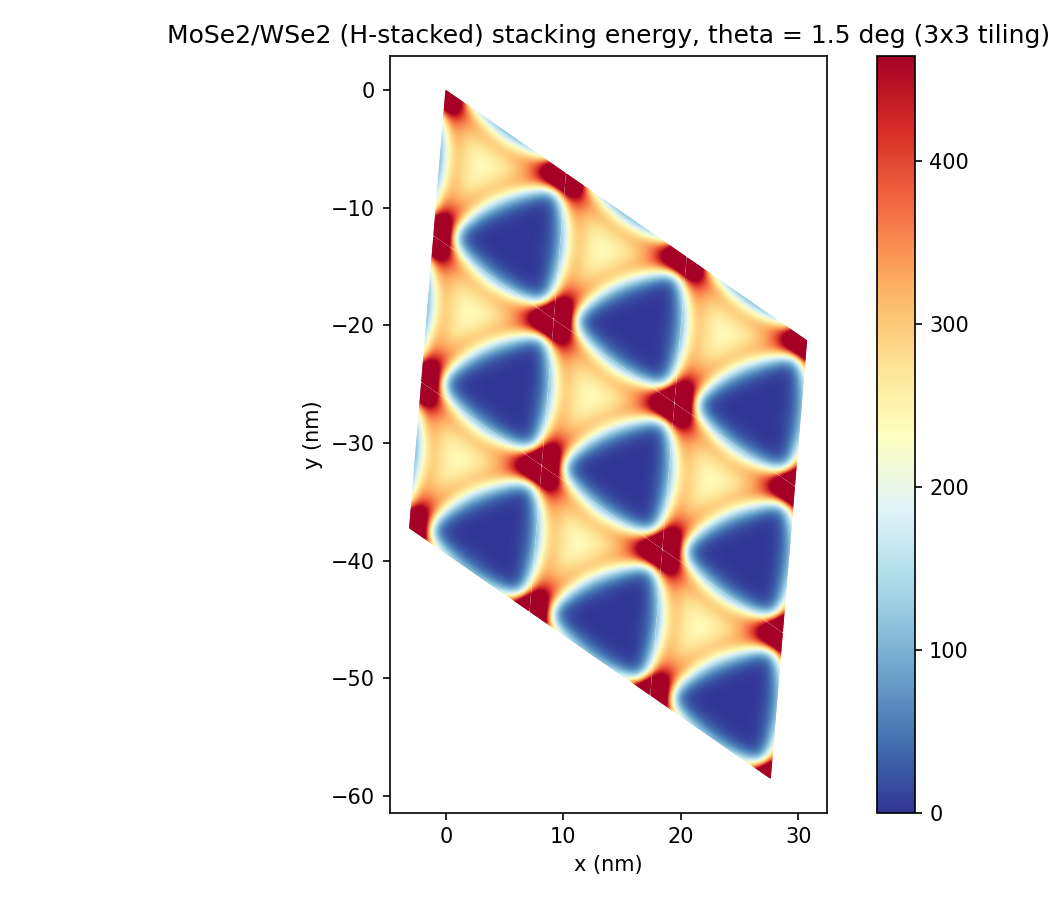
H-stacked MoSe2/WSe2 stacking energy. The broken inversion symmetry produces three distinct stacking minima (XX’, MX’, MM’) per moire cell, unlike the two-fold AB/BA pattern of graphene.
Custom interface from TOML
python bilayer_relaxation.py --interface my_interface.toml --theta-twist 0.5
See custom-materials.md for the TOML schema.
Key CLI arguments
Flag |
Description |
Default |
|---|---|---|
|
Bundled name or TOML file path |
|
|
Named preset (graphene, hbn, tmd) |
graphene |
|
Twist angle in degrees |
0.2 |
|
Mesh element size in nm |
1.0 |
|
Solver: newton, L-BFGS-B, pseudo_dynamics |
newton |
|
Max solver iterations |
60 |
|
Gradient tolerance |
1e-6 |
|
Re-solve, ignoring cache |
|
|
Skip plot generation |
|
|
Output directory |
examples/output/ |
|
Print all bundled interfaces and exit |
Outputs
All outputs are named by a slug derived from the interface name
(e.g. graphene_graphene_stacking.png):
<slug>_relaxed.npz– cached relaxed state<slug>_stacking.png– GSFE / stacking energy density<slug>_elastic.png– elastic energy density (top layer)<slug>_twist.png– local twist angle map<slug>_summary.txt– scalar diagnostics
multilayer_penetration.py
Demonstrates how moire relaxation penetrates deep into a multi-layer substrate. Only homobilayer interfaces are supported (the internal flake stacking requires the same material on both sides).
# Default: 60/60 graphene at 0.035 deg
python multilayer_penetration.py

# Smaller stack, faster
python multilayer_penetration.py --n-top 5 --n-bottom 12 --theta-twist 0.5

# hBN homobilayer
python multilayer_penetration.py --interface hbn-aa --theta-twist 0.5 --n-top 5 --n-bottom 12
Additional flags: --n-top, --n-bottom, --min-mesh-points,
--linear-solver, --linear-solver-tol, --linear-solver-maxiter.
If you pass a heterointerface or a TOML-loaded interface without a stacking function, the script exits with a clear error message.
Sample output: 60/60 graphene at 0.035 deg
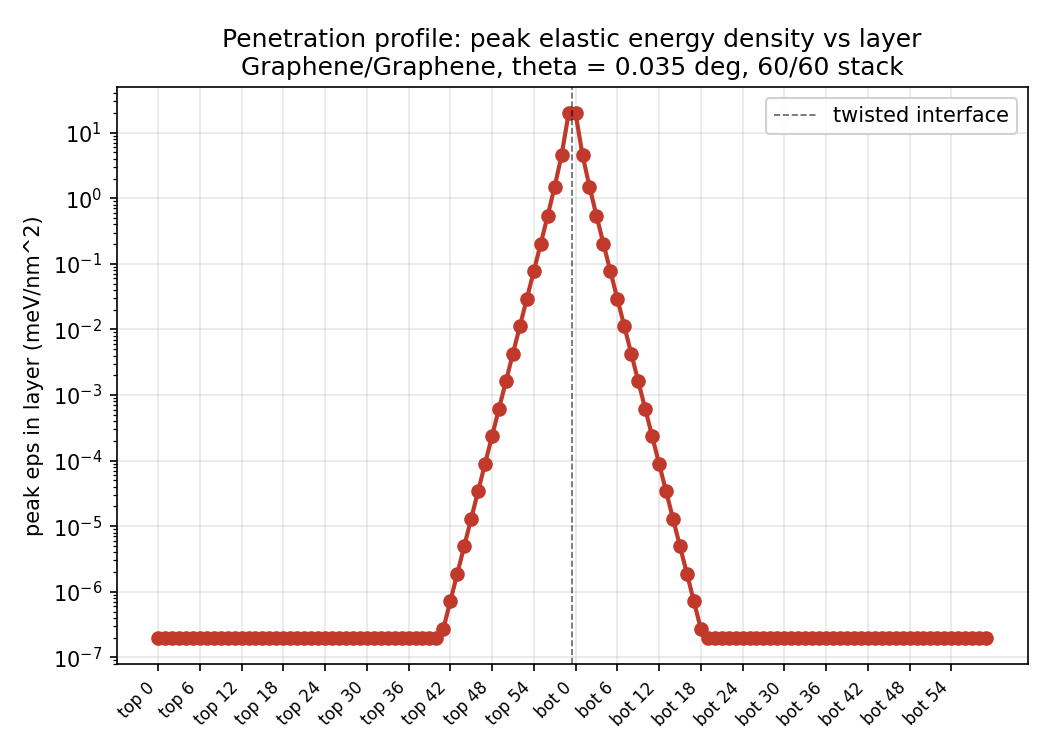
Peak elastic energy density vs layer index. Relaxation decays exponentially from the twisted interface into both flakes.
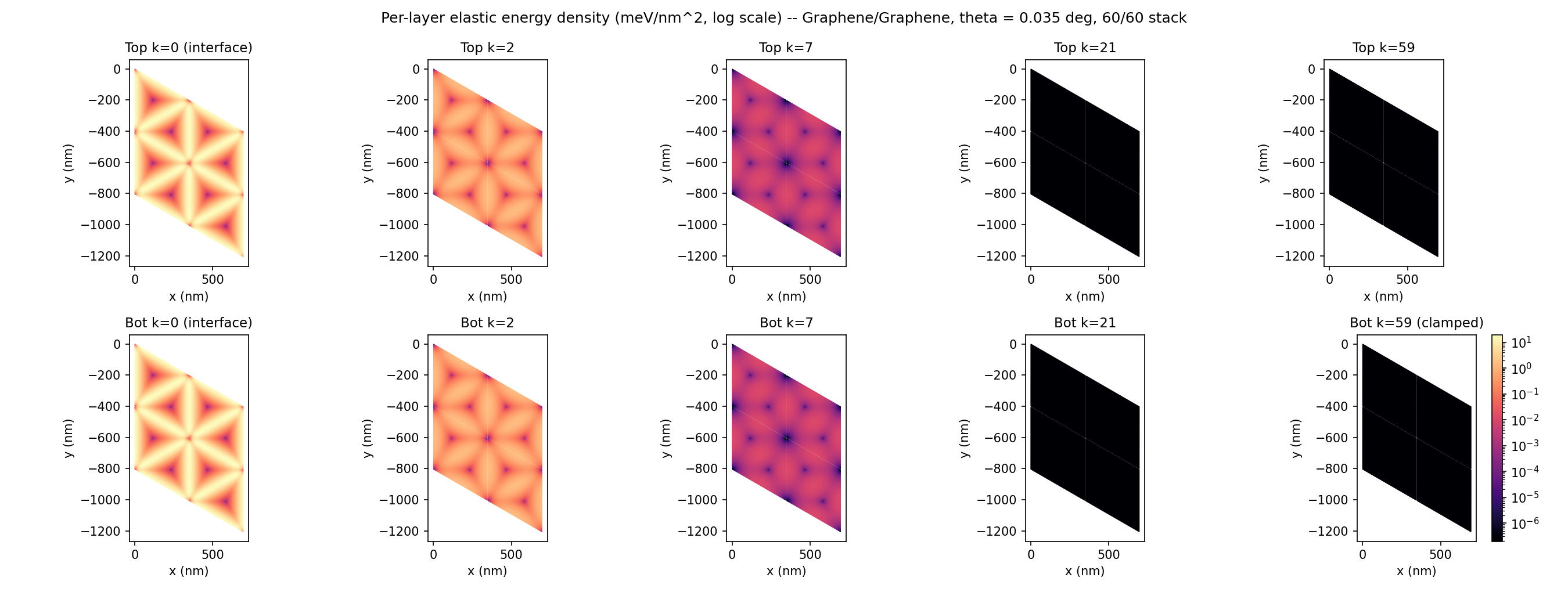
Per-layer elastic energy density maps showing the soliton network fading as it penetrates deeper into the stack.
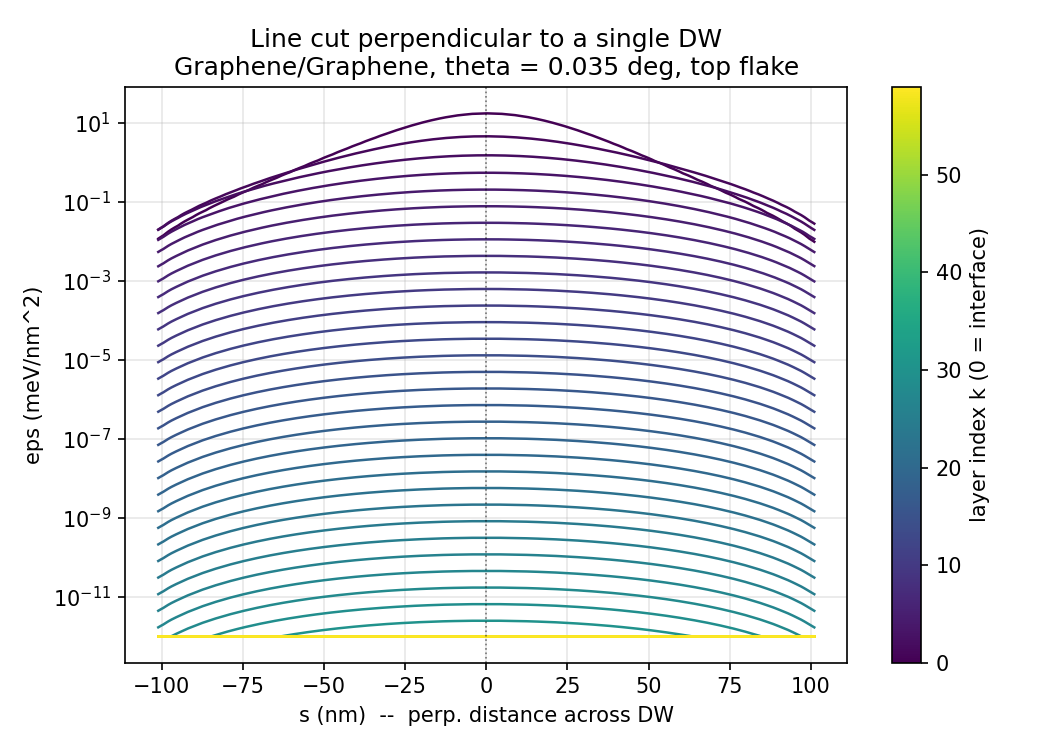
Domain-wall line cuts showing broadening of the soliton network with increasing depth from the twisted interface.
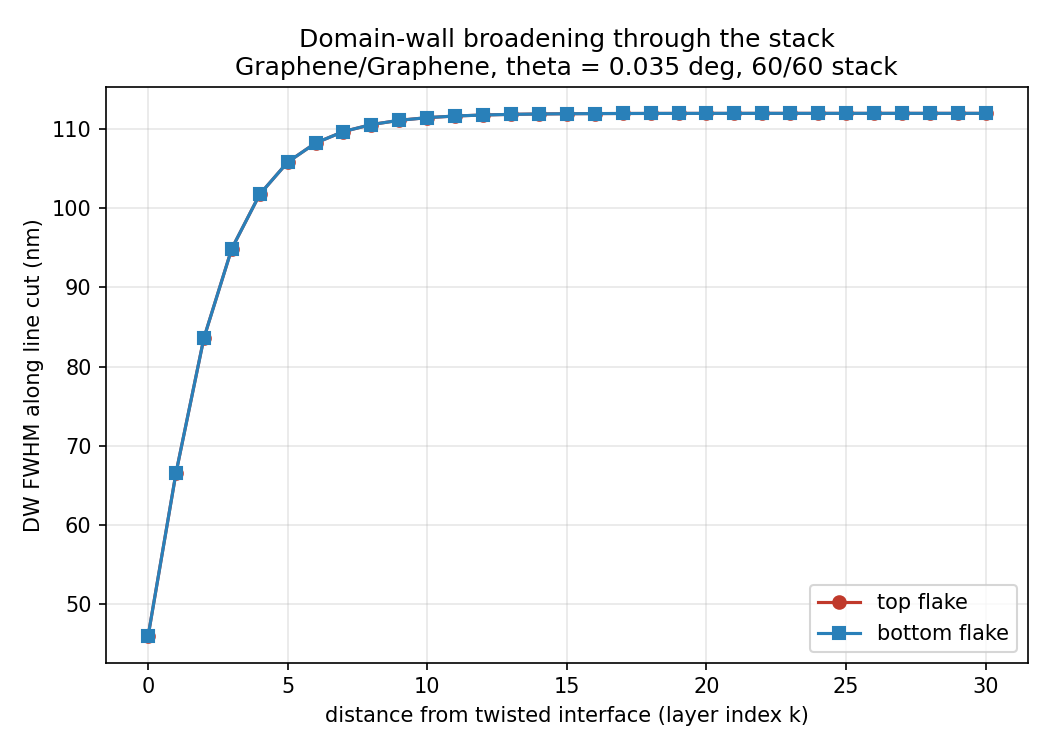
Domain-wall FWHM vs layer index, quantifying the broadening.
strain_extraction_and_pinning.py
Two-part example:
Part A: Inverse strain extraction sweep (no relaxation). Recovers twist angle and strain from moire lattice vectors, sweeping the inter-vector angle.
Part B: Constrained finite-mesh relaxation with imposed heterostrain. Pins high-symmetry sublattice sites to a uniform strain field and relaxes the GSFE + elastic energy.
# Both parts with defaults
python strain_extraction_and_pinning.py

# Only Part B with a different interface
python strain_extraction_and_pinning.py --skip-part-a --interface graphene-hbn --theta-twist 0.3

# Custom heterostrain
python strain_extraction_and_pinning.py --heterostrain 0.02
Sample output: Part A strain extraction sweep
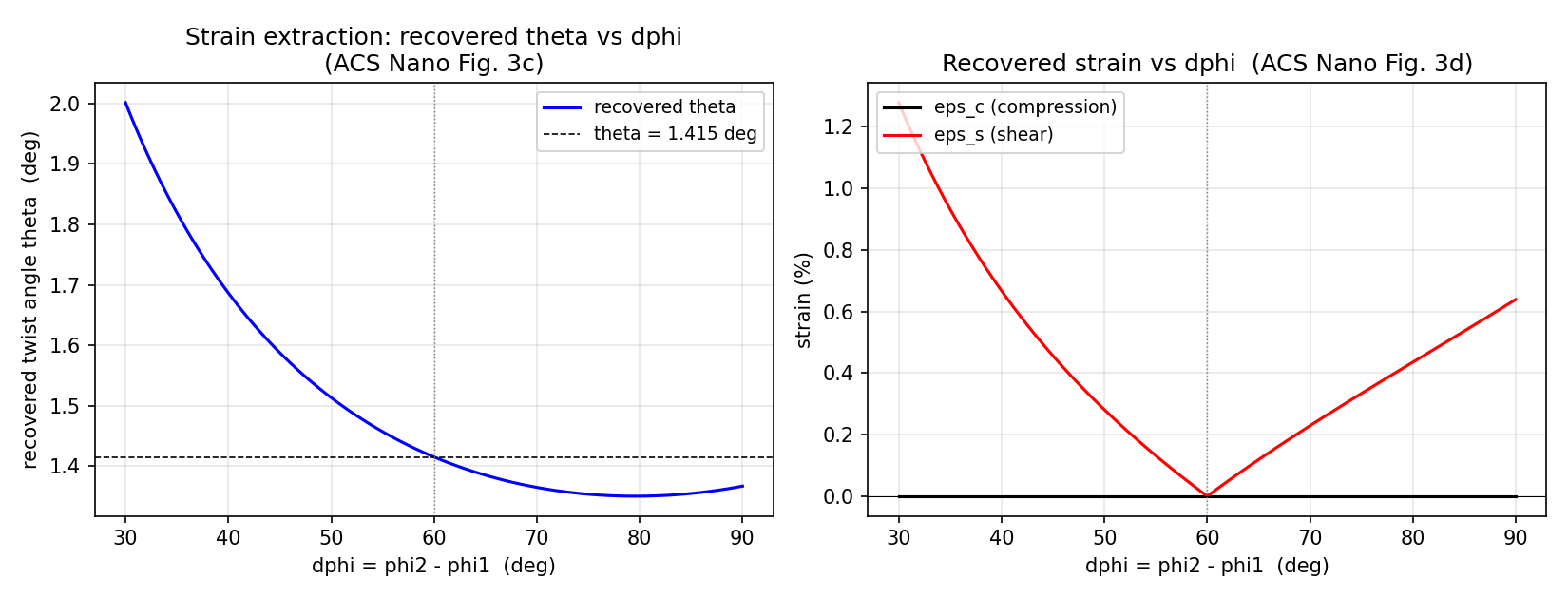
Recovered twist angle (left) and strain components (right) as a function of the inter-vector angle, reproducing Fig. 3c-d of Halbertal et al., ACS Nano 16, 1471 (2022).
spatial_strain_relaxation.py
End-to-end pipeline: loads polyline data from a CSV file, fits registry polynomials, extracts the spatially-varying strain field, and runs a constrained relaxation. Reproduces Fig. 1c-e of Halbertal et al. ACS Nano 16, 1471 (2022).
The bundled polyline data is at examples/data/mose2_wse2_polylines.csv.
All pipeline parameters are configurable:
python spatial_strain_relaxation.py --poly-degree 11 --phi0 -65.6 --n-cells 55
Sample output
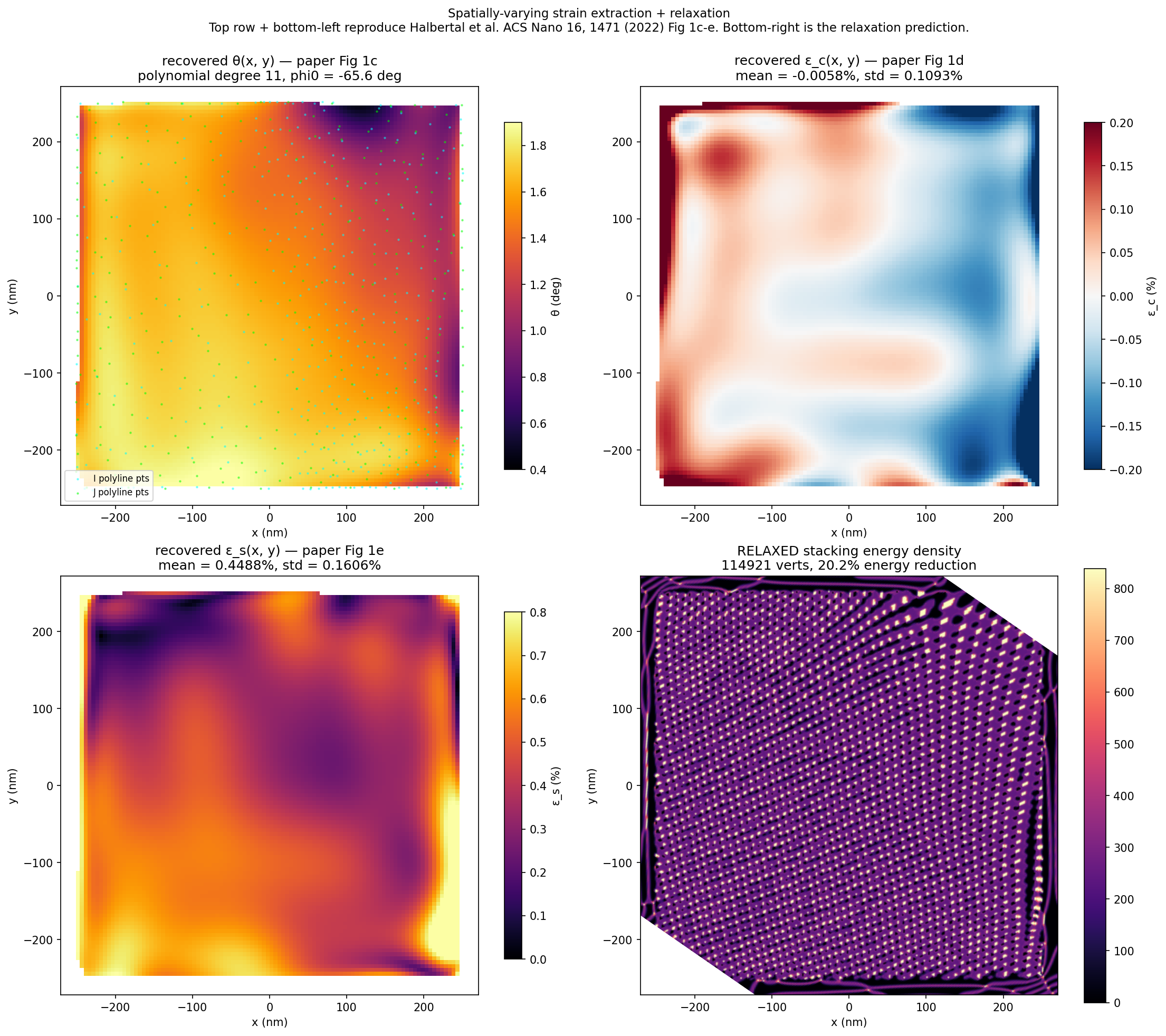
Four-panel headline figure. Top row + bottom-left reproduce the spatially-varying strain extraction from traced moire fringes (twist angle, compression strain, shear strain — cf. paper Fig. 1c-e). Bottom-right shows the constrained relaxation result: the equilibrium stacking-energy density aligned with the traced polylines.